Autobiography & memory
Augustine: a life reread
Memory becomes an address to God
Around 400 CE · retrospective Latin Christian confession
A reading in development. Editorial commentary and connections are provisional, awaiting human review; quoted source texts are identified separately.
Read the Confessions · Pusey translationThe opening · Confessions I.1
Before the story of his life, a question.
Thou awakest us to delight in Thy praise; for Thou madest us for Thyself, and our heart is restless, until it repose in Thee. Grant me, Lord, to know and understand which is first, to call on Thee or to praise Thee? and, again, to know Thee or to call on Thee?
Compare the words with the painting
Look at the heart in his hand, the writing quill and the light marked VERITAS (“truth”). Champaigne gives an inward address a visible form. Those are the choices of a seventeenth-century painter.
What can that image hold together that the opening leaves as a question?
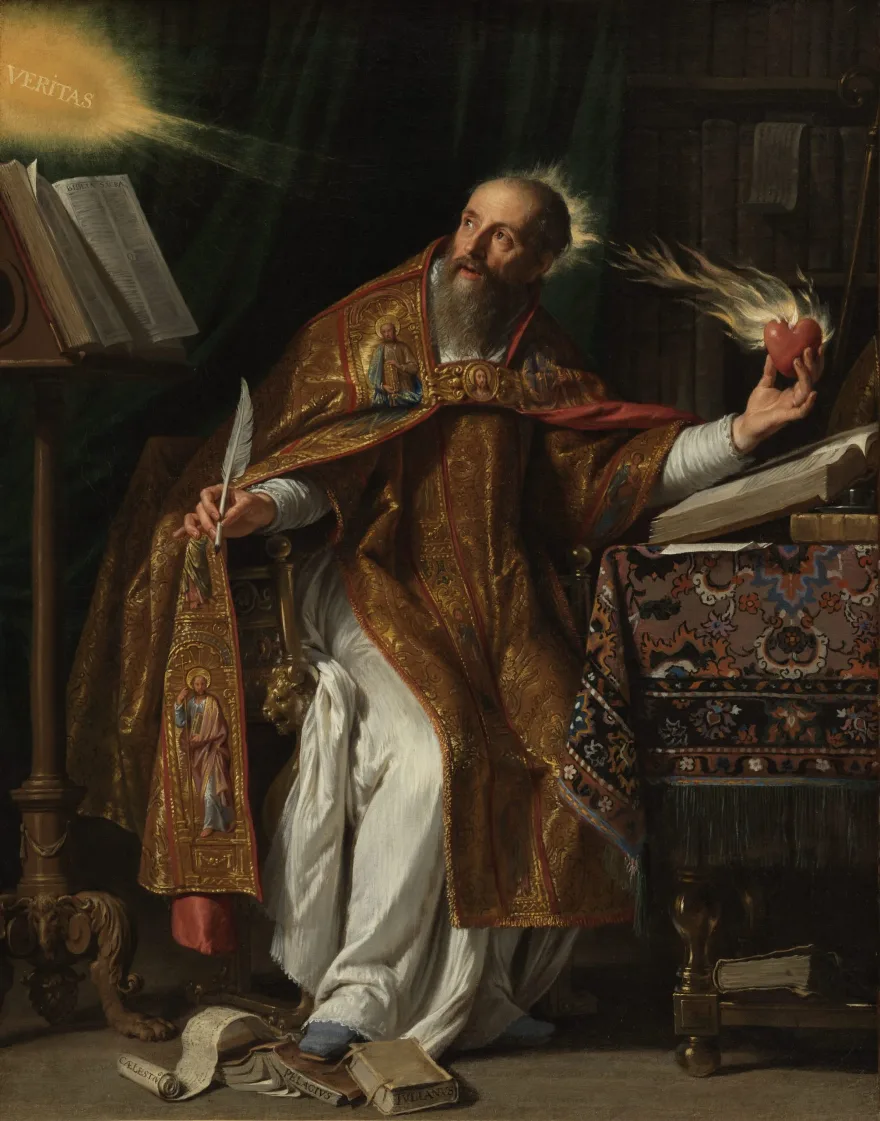
Champaigne’s Augustine, circa 1645. A writer pictured with a burning heart.
Look closer · image & source
Later devotional art, not a portrait from Augustine’s lifetime. The heart and light are the painter’s imagery.
Philippe de Champaigne, Saint Augustine, circa 1645. Gift of The Ahmanson Foundation, LACMA. Photo: Museum Associates/LACMA.
Source record · Public domain (underlying painting and faithful two-dimensional reproduction in the United States)
circa 1645
Open the complete imageThe Confessions tells a life, but its listener is God. Memory, other people's stories and the reading of Scripture become part of Augustine's account of change.
Who is being addressed?
The opening is prayer before it is a chronological account. Augustine narrates his remembered actions and desires while asking about God, knowledge and praise. A reader is listening in on that address. His confession offers a theological interpretation of a life, not a detached record of every event in it.
A reading in a garden
In book VIII, Augustine recounts hearing a child's repeated words and taking them as a command to read. He opens an apostolic book and reads a passage associated with Romans. Preserve the difference between his recollection of a sound, the action he takes and the divine significance he gives it.
The life opens back into Scripture
Interpretation
The work continues beyond the conversion narrative. Its later books turn to memory, time and the opening of Genesis. Augustine's reading of creation is therefore an actual part of this work, not an association added merely because both subjects feel profound. Read Genesis alongside him, while keeping his interpretation distinct from its text.
Another reader, centuries later
In chapter 9 of her own Life, Teresa of Ávila explicitly recalls receiving and reading Augustine's Confessions, including his account of conversion in the garden. This is a documented connection between two works: Teresa herself tells us that she read him. What she makes of the encounter remains her own spiritual testimony.
Source: Teresa of Ávila · The LifeSource: Augustine · Confessions
Sources & limits
Read the passage. Inspect the kind of evidence. Keep its limits in view.
Augustine to Jerome · Letter 71 — Interpretation
Augustine to Jerome · Letter 71: open source
Where to look: Chapter 3, §5 (Oea and Jonah); chapter 4, §6 (versions)
Letter 71 in Augustine's collection / 104 in Jerome's; dated 403 in this edition. J. G. Cunningham translation, NPNF I.1 (1887), revised by New Advent.
Limits: Augustine reports an incident at Oea; he is not presenting an independently verified transcript. His remarks about Jewish residents are his polemical framing, not the editorial voice of BibleMap.
Historical translation; modern New Advent presentation has its own copyright. Original paraphrase only.
Source checked 2026-11-01.
The Passion of Perpetua and Felicity — Autobiography & memory
The Passion of Perpetua and Felicity: open source
Where to look: Prologue §§1–2; Perpetua's attributed account §§3–10; Saturus §§11–13; Felicity §15; narrative ending §§16–21
W. H. Shewring translation (1931), modernized for Fordham's Internet History Sourcebooks with reference to Peter Dronke. Read the site's section headings as well as the narrative.
Limits: A composite Passion, not a surviving autograph. The editor attributes §§3–10 to Perpetua; Saturus's vision and the third-person ending are distinct layers. Visions are reported experiences, not externally verified events.
Fordham's electronic form permits educational/personal copying with attribution and restricts commercial reuse. The experience links it and uses original editorial paraphrase only; no translated speech, scan or edition layout is reproduced.
Source checked 2026-11-01.
Augustine · Confessions — Autobiography & memory
Augustine · Confessions: open source
Where to look: Book I opening; VIII.12 (garden); IX (Monica and singing); XI–XIII (time and Genesis)
E. B. Pusey translation, Project Gutenberg eBook 3296. Work composed around 400 CE; the remembered events precede the writing.
Limits: Retrospective Christian confession addressed to God, not an unmediated diary or a neutral transcript. Theological self-interpretation belongs to the work's form.
Historical public-domain translation linked. The interior opening quotes a credited excerpt from Book I.1; other sections use editorial paraphrase.
Source checked 2026-11-01.
Teresa of Ávila · The Life — Autobiography & memory
Teresa of Ávila · The Life: open source
Where to look: 9.8–10 (reading Augustine); 11.6–12 (garden and four ways of watering); prologue
David Lewis translation, third edition with introduction/notes by Benedict Zimmerman, 1904; Project Gutenberg eBook 8120. Distinguish Teresa's chapters from later editorial notes.
Limits: A sixteenth-century Carmelite Catholic account of prayer and spiritual experience, written in obedience to requests to describe it. Later notes are not Teresa's words. Her account of divine action is her theological testimony.
Historical translation linked; no translated quotation reproduced.
Source checked 2026-11-01.
Genesis 1 — Scripture
Where to look: 1:1–31, especially 1:26–31
World English Bible, updated 66-book edition (engwebp). Read 2026-11-01; summaries are editorial, not quotations.
Limits: A biblical narrative is read as Scripture. The summary does not independently establish dates, locations or archaeological corroboration.
World English Bible: public domain. No new Scripture quotation reproduced here.
Source checked 2026-11-01.
About this reading
Sourced editorial draft for PR #36, awaiting human review. Connections are authored and individually classified. A comparison does not claim historical influence, and a later interpretation is not Scripture.