Perpetua
The Prison
“I obtained for my infant to remain in the dungeon with me”Attributed to Perpetua · Passion §3Enter the account
R. E. Wallis translation, 1885
Carthage · traditionally dated 203 CE
Perpetua & Felicity
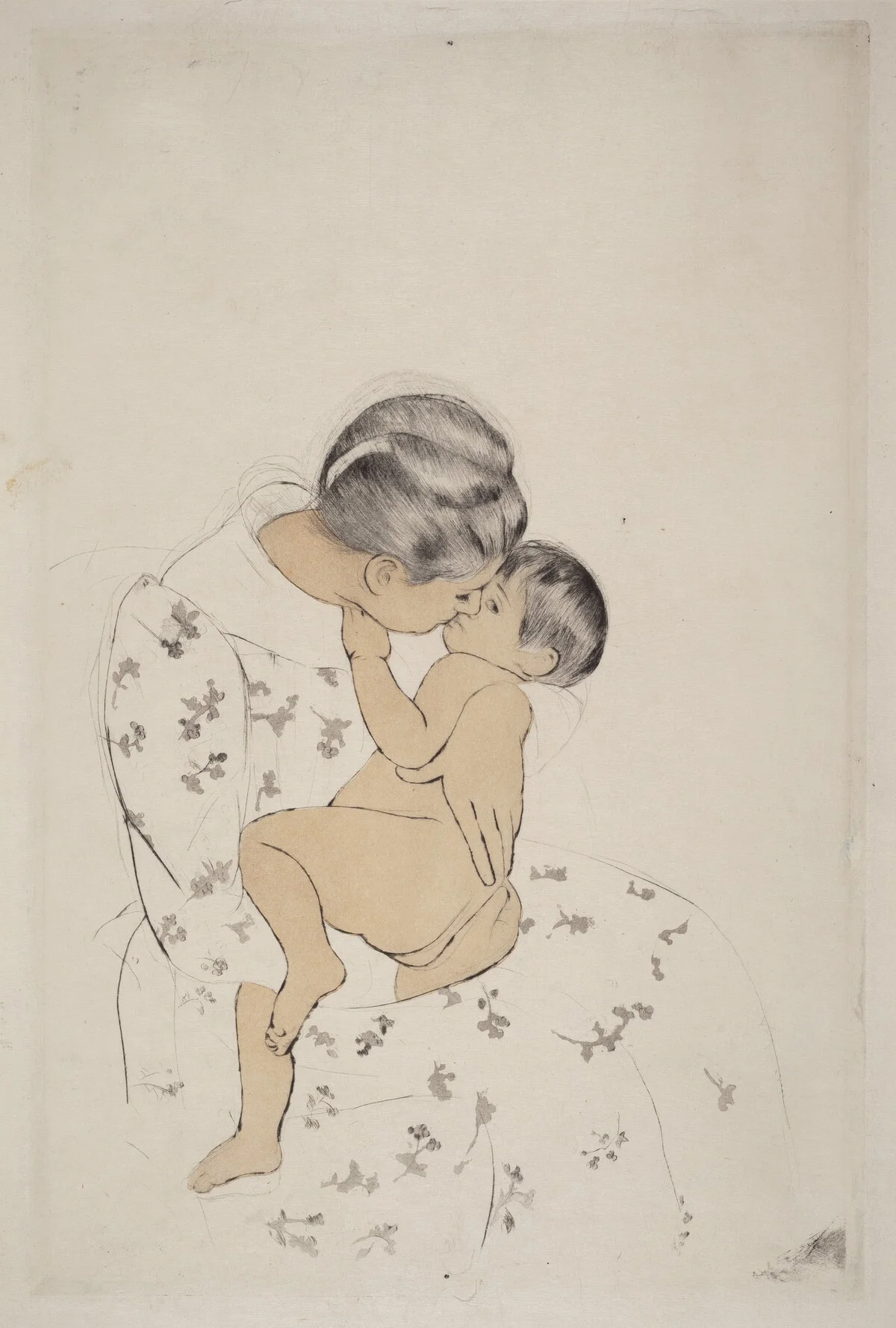
Mary Cassatt, Mother’s Kiss, 1890–1891.
An artistic parallel, not a portrayal of Perpetua. Image & source
A story in development · about this encounter
The editorial summaries and questions are provisional, awaiting historical and theological review. Attributed testimony is identified separately. The entrance pairs a nineteenth-century image of maternal closeness with the ancient account. It is an artistic comparison, not a historical likeness.
The complete encounter
Six scenes from the transmitted Passion. The sequence is editorial; source sections are identified throughout.
1 / 6The child
Account attributed to Perpetua
A child in the prison.
An artistic parallel, not Perpetua. NGA, CC0. Image & source
“the dungeon became to me as it were a palace”
Attributed account, §3 · Wallis, 1885
The prison is crowded and hot. In the account attributed to her, Perpetua fears its darkness. Her account keeps returning to someone else: her nursing child.
The deacons obtain a respite. She nurses the hungry child. Later, he is allowed to stay with her. A place of confinement becomes, in her telling, a palace.
People and the account’s limits
Follow a relationship
A nursing infant
Her care for him gives the prison account its immediate bodily stakes. His hunger and presence are described by her; his own experience does not reach us in a separate voice.
Explore the people in this passage
Her child
Her care for him gives the prison account its immediate bodily stakes. His hunger and presence are described by her; his own experience does not reach us in a separate voice.
Her family
She describes speaking to her mother and strengthening her brother while commending the child to them. This network of care exists inside the account; it is not a recovered family testimony.
The deacons
The account names two deacons who obtain, with money, a short respite in a better part of the prison. Their help changes access within confinement, not the sentence that comes later.
Passion §3; attribution introduced in §2
Inspect this passage
Section 3 describes the heat, crowding, soldiers and concern for the infant. Two deacons obtain a respite; she nurses him. His later presence in prison brings relief. This is her account's description, received within an edited work.
We possess the transmitted composite work, not an inspected autograph or the child's account. Its editor attributes §§3–10 to Perpetua. That attribution is part of what the source asks us to examine.
Read the complete source at FordhamOriginal editorial summary. The separately marked translated passage, where present, is historical source language.
2 / 6The hearing
Account attributed to Perpetua
Her father brings the child.
Have pity my daughter, on my grey hairs.
Passion §5 · ANF II.1R. E. Wallis translation, 1885 · public domain
These things said my father in his affection, kissing my hands, and throwing himself at my feet; and with tears he called me not Daughter, but Lady.
Passion §5 · ANF II.1R. E. Wallis translation, 1885 · public domain
Spare the grey hairs of your father, spare the infancy of your boy, offer sacrifice for the well-being of the emperors.
Passion §6 · ANF II.2R. E. Wallis translation, 1885 · public domain
I am a Christian.
Passion §6 · ANF II.2R. E. Wallis translation, 1885 · public domain
Three speaking positions. One attributed account.
These are not independently preserved depositions.
After her father is struck
And my father’s misfortune grieved me as if I myself had been beaten, I so grieved for his wretched old age.
Passion §6 · ANF II.2R. E. Wallis translation, 1885 · public domain
Her father asks her to consider her family. At the hearing, he appears with her son; the official also invokes the child and asks her to sacrifice.
She continues to identify as Christian. The account reports condemnation to the beasts, and her sorrow when her father is struck.
Why sacrifice? Family, belief and public allegiance
Source-backed reading note · editorial draft
In the hearing as she tells it, the official asks for sacrifice for the emperors’ well-being. Her father appeals through the life he has helped her reach, the family’s standing, and the child who depends on her. These demands meet in one public encounter.
In a separate Christian defense, Tertullian says Christians pray for emperors’ safety while rejecting sacrifice to the gods. That distinction helps make refusal intelligible within this religious world. It does not make the official’s words a neutral transcript or establish Perpetua’s own reasoning.
What can a parent ask of an adult child? What does conviction cost the people who depend on someone else’s decision? These are questions raised by this juxtaposition, not answers supplied by the source.
Passion §§5–6 · Wallis, ANF III (1885), II.1–2
Tertullian, Apology 29–32 · S. Thelwall, ANF III (1885); New Advent revision. A polemical defense, not testimony to this hearing.
People and the account’s limits
Follow a relationship
As reported by Perpetua
His appeal names family ties. She describes his grief and her own sorrow for him. Reading him only as an obstacle would erase part of what her account preserves.
Explore the people in this passage
Her father
His appeal names family ties. She describes his grief and her own sorrow for him. Reading him only as an obstacle would erase part of what her account preserves.
The official
Hilarian's demand for sacrifice and his sentence are reported here. The interface has no separate deposition from him to set beside hers.
Her child
Her son appears with her father and in the appeal to sacrifice. We are told how others invoke him, not what he understands.
Passion §§5–6
Inspect this passage
Section 5 gives the father's appeal and her response; §6 places father, infant and official at the tribunal. All their words reach us within the account attributed to Perpetua, rather than as three independently preserved statements.
The Passion is a Christian martyr narrative, not a surviving official transcript. The father's motives cannot be reconstructed beyond what this account says about him.
Read the complete source at FordhamOriginal editorial summary. The separately marked translated passage, where present, is historical source language.
3 / 6The separation
Account attributed to Perpetua
She asks for her child.
Her father will not give him back. His reason is not given.
Cassatt, Mother’s Kiss, 1890–1891. NGA, CC0. Artistic parallel; not Perpetua.
Passion §3 · ANF Argument I.2
Such solicitude I suffered for many days, and I obtained for my infant to remain in the dungeon with me; and forthwith I grew strong and was relieved from distress and anxiety about my infant; and the dungeon became to me as it were a palace, so that I preferred being there to being elsewhere.
Read this section in the Wallis editionR. E. Wallis, 1885 · public domainImage provenance
Such solicitude I suffered for many days, and I obtained for my infant to remain in the dungeon with me; and forthwith I grew strong and was relieved from distress and anxiety about my infant; and the dungeon became to me as it were a palace, so that I preferred being there to being elsewhere.
After the sentence · Passion §6
Then, because my child had been used to receive suck from me, and to stay with me in the prison, I send Pomponius the deacon to my father to ask for the infant, but my father would not give it him. And even as God willed it, the child no [longer] desired the breast, nor did my breast cause me uneasiness, lest I should be tormented by care for my babe and by the pain of my breasts at once.
R. E. Wallis, 1885, public domain. “No [longer]” corrects “no long” in the electronic transcription. These are translated words from the transmitted work.
First, relief comes when the child can stay. Later, the account places relief after separation and attributes it to God’s will. The father’s reason for refusing the request is not given.
Reading note · provisional commentary. This paragraph does not tell us the child’s later life.
How a later image holds them together
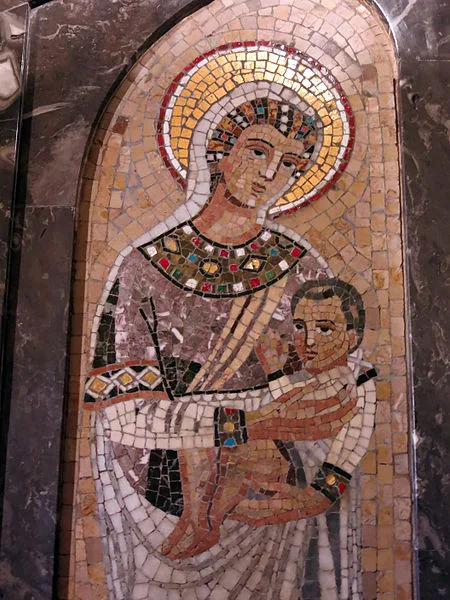
Perpetua and her child, Montserrat. Devotional mosaic; artist and date unknown.
Look closer · image & source
Later devotional art. It does not establish the appearance of Perpetua, her son or the prison.
Enric / Wikimedia Commons, CC BY-SA 3.0. Via Perpetua and Felicitas Exhibit. Resized and converted to WebP.
Mosaic date: unknown. Photograph: January 4, 2015. Source of mosaic’s artist and date: unknown.
Open the complete imagePeople and the account’s limits
Follow a relationship
Withheld after the hearing
The text records her unsuccessful request. It does not provide the child's later story. The later mosaic holds mother and child together in an image; it cannot supply that missing history.
Explore the people in this passage
Her child
The text records her unsuccessful request. It does not provide the child's later story. The later mosaic holds mother and child together in an image; it cannot supply that missing history.
Her father
His refusal is reported in the same paragraph as her relief. The text does not give a fresh explanation in his own voice; we cannot supply one.
Her interpretation
The account interprets relief from bodily distress as God's will. Keeping that interpretation visible lets us hear her faith without treating its causation as independently verified history.
Passion §6, after the sentence
Inspect this passage
The last part of §6 records the request, refusal, the child's no longer needing to nurse and Perpetua's bodily relief. The account presents the relief as God's will.
That theological explanation belongs to the attributed account. This paragraph does not tell us the child's later life; the experience leaves that absence open.
Read the complete source at FordhamOriginal editorial summary. The separately marked translated passage, where present, is historical source language.
4 / 6The vision
A vision reported by Perpetua
The night before the games.
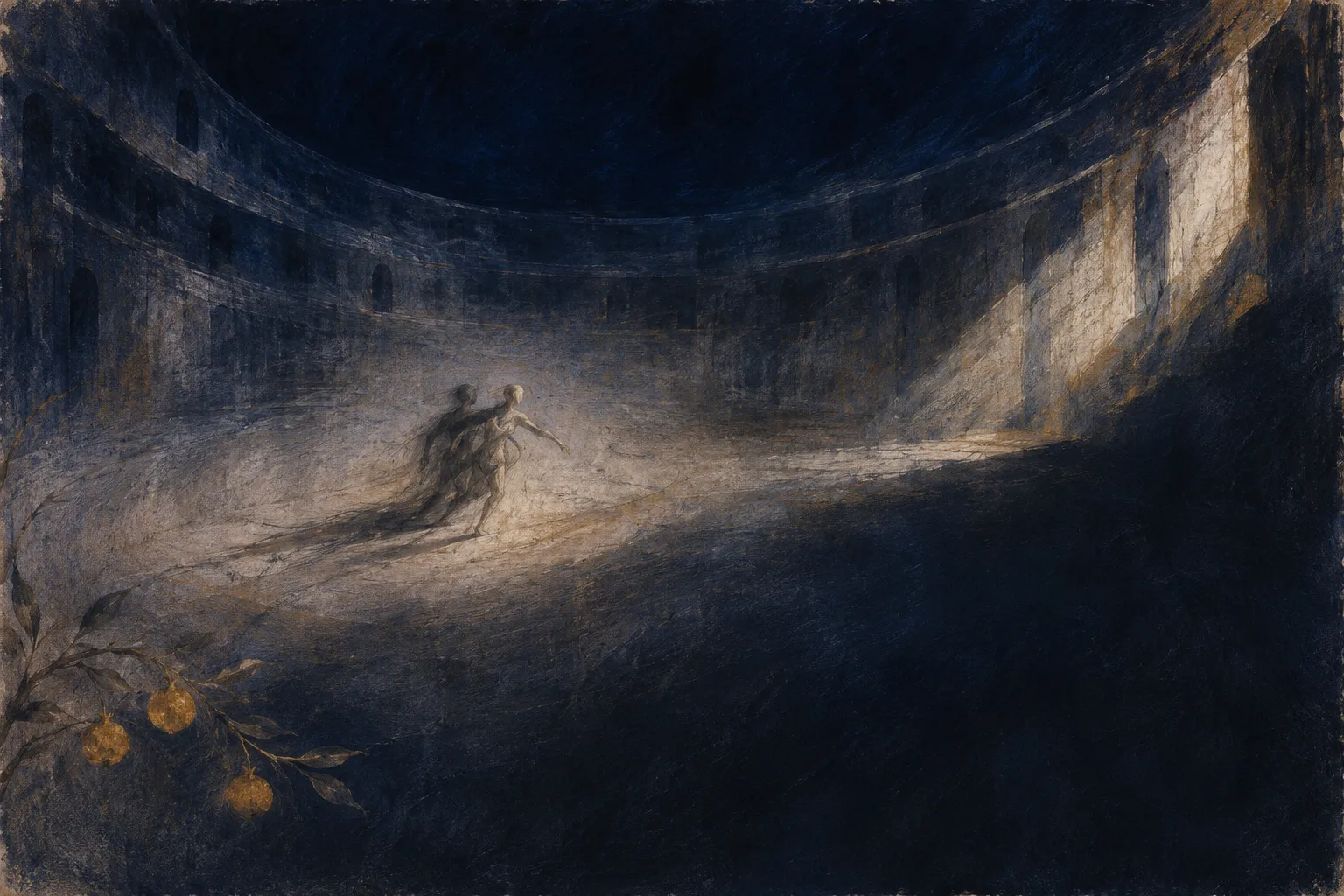
Creation, source imagery & limits
The expected beasts
And because I knew that I was given to the wild beasts, I marvelled that the wild beasts were not let loose upon me.
The account names an Egyptian opponent instead. A public sentence becomes a different kind of contest inside the vision.
Passion §10 · ANF III.2
Within the reported vision · R. E. Wallis, 1885
A changed body
And there came to me, as my helpers and encouragers, handsome youths; and I was stripped, and became a man.
Helpers rub the body with oil. The trainer offers a branch with golden apples. After the contest he calls her ‘Daughter’. The vision’s changes do not erase its gendered language.
Passion §10 · ANF III.2
Within the reported vision · R. E. Wallis, 1885
On waking
Then I awoke, and perceived that I was not to fight with beasts, but against the devil.
She interprets the struggle through her faith and expects victory. This is still before the games. The account of her death will come from another writer.
Passion §10 · ANF III.2
Perpetua’s interpretation of her vision · R. E. Wallis, 1885
Reading notes · provisional interpretation of Passion §10
The sentence is to the beasts. In the vision, she meets an opponent instead; her body changes, and she receives a branch with golden fruit. On waking, she understands the struggle as a fight against the devil.
The vision gives her an expectation of victory before the public games. Her own writing stops here. Another narrator will describe what happens there.
How does a vision change what she expects?
Source-backed reading note · editorial draft
Earlier, her brother asks whether to expect suffering or release. The ladder, serpent and garden of §4 are interpreted by the siblings as pointing toward martyrdom. Here, in §10, the sentence to the beasts becomes a contest with an opponent, a transformed body and a reward.
The account itself moves from seeing to waking to interpretation. It offers faith’s explanation without requiring us to mistake the scene for a record of the public games. The phrase “became a man” is retained rather than explained away; this encounter does not settle its gender, athletic or theological meanings.
Passion §4 · Wallis, ANF I.3; §10 · ANF III.2. These are passages of the same transmitted work, not independent corroboration.
People and the account’s limits
Follow a relationship
The reported vision
The text describes an arena contest with an opponent and a victor's reward. It is presented as a vision, not as the public games that the later narrator describes.
Explore the people in this passage
What is seen
The text describes an arena contest with an opponent and a victor's reward. It is presented as a vision, not as the public games that the later narrator describes.
What it means to her
On waking she identifies the struggle as against the devil and understands herself as victorious. The interpretation is hers within this account; the visitor is not asked to verify a supernatural scene.
The earlier vision
An earlier vision describes a ladder, a serpent and a garden. She and her brother interpret it in relation to the coming passion. It is another passage in the same source family, not independent corroboration.
Passion §10; an earlier vision appears in §4
Inspect this passage
Section 10 explicitly identifies the episode as a vision, describes the contest and gives her waking interpretation. The attributed account ends after this section, before the games themselves.
A reported vision is evidence of what the work says she experienced and understood. It does not independently establish the vision's events or a universal interpretation of its imagery.
Read the complete source at FordhamOriginal editorial summary. The separately marked translated passage, where present, is historical source language.
5 / 6Felicity
Felicity described by the narrator
She fears being left behind.
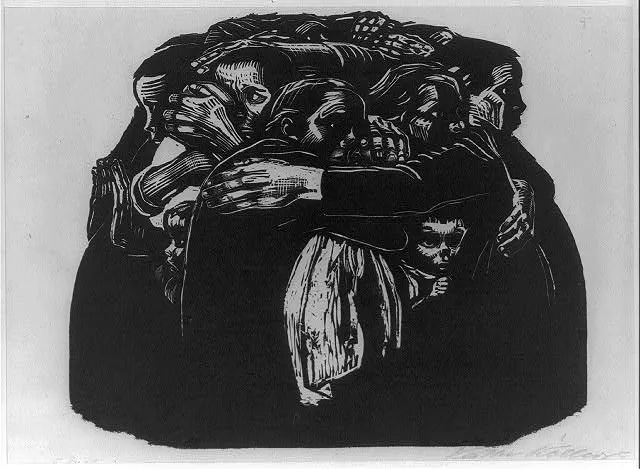
Library of Congress. Public domain. An artistic parallel.
The print’s own world & source
A group gathered around children.
A story about the fear of being left behind.
The narrator describes the pregnant Felicity among the prisoners. She fears being left behind when her companions die. They grieve at the thought of leaving her and pray together. Then her labour begins.
An attendant asks how she will bear the beasts if childbirth hurts so much. The reply reported by the narrator places her hope in someone who will suffer in her. Another woman will raise her daughter.
Felicity does not leave a corresponding first-person account in this text. Her reported words and experience come through the narrator's telling.
Now it is I that suffer what I suffer; but then there will be another in me, who will suffer for me, because I also am about to suffer for Him.
Passion §15 · ANF V.2R. E. Wallis translation, 1885 · public domain
Thus she brought forth a little girl, which a certain sister brought up as her daughter.
Passion §15 · ANF V.2R. E. Wallis translation, 1885 · public domain
Status, companionship and what the narrator preserves
Source-backed reading note · editorial draft
The opening frame describes Perpetua as well-born and educated, and Felicity as Revocatus’s fellow servant. It does not say Perpetua owned Felicity. Their social positions should not disappear because both are mothers.
The narrator says Felicity fears being left behind when the others die. Her companions grieve at that possibility and pray with her. After she gives birth, another woman raises her daughter. Childbirth, the wish to remain with the group and the continuing care of a child coexist here; no inner monologue survives to reconcile them for us.
Passion §2 · Wallis, ANF I.1; §15 · ANF V.2. The narrator’s legal remarks are not used here as a general account of Roman law.
People and the account’s limits
Follow a relationship
Through the narrator
Her speech is represented by another voice. The interface keeps that mediation explicit rather than giving her an invented diary or interior monologue.
Explore the people in this passage
Felicity
Her speech is represented by another voice. The interface keeps that mediation explicit rather than giving her an invented diary or interior monologue.
Her daughter
The narrator says another woman takes Felicity's daughter to rear. This is a reported act of care, not a separate account from either woman or from the child.
The companions
The narrator presents her companions praying on her behalf. This is part of the Passion's Christian understanding of community and suffering, not a neutral recording of the room.
Passion §15
Inspect this passage
Section 15 presents Felicity's situation, prayer, childbirth, reported answer to a prison attendant and the daughter's care. The account attributed to Saturus is separate: his vision occupies §§11–13; the narrator resumes in §14.
The absence of a first-person segment here does not mean Felicity had no voice or never wrote. It limits our access through this particular work. Its legal remarks are not treated here as a complete statement of Roman law.
Read the complete source at FordhamOriginal editorial summary. The separately marked translated passage, where present, is historical source language.
6 / 6The ending
The narrator carries the account onward
Someone else finishes.
This, so far, I have completed several days before the exhibition; but what passed at the exhibition itself let who will write.
Passion §10 · ANF III.2R. E. Wallis translation, 1885 · public domain
The narrator continues
So she rose up; and when she saw Felicitas crushed, she approached and gave her her hand, and lifted her up. And both of them stood together;
Passion §20 · ANF VI.3R. E. Wallis translation, 1885 · public domain
The writing attributed to Perpetua stops before the games. The final narrator describes Perpetua and Felicity in the arena and their deaths.
The work understands their martyrdom as victory. That ending is not Perpetua reporting her own death. A different voice has brought us here.
Perpetua and her child, Montserrat; artist and date unknown.
Photo: Enric, CC BY-SA 3.0. Image & source
Who composed the voice we have been reading?
Source-backed reading note · editorial draft
The work attributes §§3–10 to Perpetua’s own hand. That attribution belongs to the transmitted text; this encounter cannot authenticate the voice. Shewring argues for distinct authentic accounts from differences in style and prose rhythm. Ellen Muehlberger proposes reading the first-person voice as a later literary composition in the tradition of speaking in a remembered woman’s character.
These readings change what we can infer about composition and experience. Neither vividness nor uncertainty alone settles authorship. The traditional 203 CE setting of the narrated events must be distinguished from the disputed date of composition.
W. H. Shewring, The Passion of SS. Perpetua and Felicity (1931), introduction xviii–xx; Ellen Muehlberger, “Perpetual Adjustment,” JECS 30.3 (2022), 313–342, especially 315–318 and 333–342. Full article access is recorded in the repository’s primary-source dossier. This is an argued alternative, not a consensus conclusion.
People and the account’s limits
Follow a relationship
The attributed account has ended
The work itself marks the limit of her writing before the games. The final scene must not be presented as another entry in her diary.
Explore the people in this passage
Perpetua's writing
The work itself marks the limit of her writing before the games. The final scene must not be presented as another entry in her diary.
The narrator
The narrator supplies the final account and its language of victory. That voice is part of the surviving work, with its own religious purpose.
The voices we lack
Her infant has no first-person account here. Felicity's experience is mediated by the narrator. A coherent story does not remove those absences.
End of Passion §10; §§14, 18–21
Inspect this passage
The end of §10 leaves the games for someone else to recount. After Saturus's vision, the narrator resumes in §14 and narrates the final events in §§18–21. The present experience summarizes that outcome without a graphic reenactment.
The source preserves a Christian interpretation of these deaths. Its composite form gives access to a life while also placing limits on whose words, perspective and experience we can recover.
Read the complete source at FordhamOriginal editorial summary. The separately marked translated passage, where present, is historical source language.
Sources, place & further reading
Place the account
Carthage is a city.
This is one surviving story.
The Atlas can orient us to Carthage. It does not establish the prison’s location or appearance, or independently verify this account.
Orient to Carthage in the AtlasCity reference: Pleiades contributors, Carthago 314921, CC BY 3.0. Modern city-scale orientation; no ancient route or exact site implied.
Other ways of telling
Pliny writes to an emperorA Roman official’s correspondence, from another time and region. An editorial comparison, not the cause of this trial.
Augustine: a life rereadA different first-person work, addressed to God. Compare how a life reaches its reader.
Return to Scripture: read JonahThe biblical narrative retains its own voice. This return does not assert a direct dependence of the Passion on Jonah.
The work that carries these voices.
The Passion’s frame attributes §§3–10 to Perpetua and §§11–13 to Saturus. A narrator introduces the prisoners and tells the ending. These are parts of one transmitted work, not a collection of independently recovered testimonies.
Edition, provenance & limits
The Passion of Perpetua and Felicity · open the source edition
W. H. Shewring translation (1931), modernized for Fordham's Internet History Sourcebooks with reference to Peter Dronke. Read the site's section headings as well as the narrative.
A composite Passion, not a surviving autograph. The editor attributes §§3–10 to Perpetua; Saturus's vision and the third-person ending are distinct layers. Visions are reported experiences, not externally verified events.
Fordham's electronic form permits educational/personal copying with attribution and restricts commercial reuse. The experience links it and uses original editorial paraphrase only; no translated speech, scan or edition layout is reproduced.
Checked 2026-11-01. Exact scene sections appear beside each passage summary.
The narrative’s traditional 203 CE setting follows the linked edition’s modern introduction. We have not inspected an autograph or independently verified each narrated event.
Quoted passages · translation & limits
The Passion: Wallis translation
Passion §§3, 5–6, 10, 15 and 20; ANF Argument I.2, II.1–2, III.2, V.2 and VI.3
R. E. Wallis, Ante-Nicene Fathers III (1885). The electronic transcription’s ‘no long’ is corrected to ‘no [longer]’. Other displayed wording retained.
The transmitted work attributes this first-person account to Perpetua. Translation, transmission and editorial framing stand between the reader and the events; the father’s reason for refusing the child is not stated.
Public-domain historical English translation. Exact excerpts credited separately from the modernized Fordham edition.
About the imagery and this encounter
The vision’s image is original AI-generated interpretive artwork, directed by Codex for BibleMap in 2026. Its arena, shifting shadows, light and golden fruit respond to §10. It is not an authentic artifact, likeness, prison plan or verified view of a vision. The hearing’s typography places reported appeals across one field; it does not reconstruct an official transcript.
The separation reading places an opaque reading surface across Cassatt’s intact print when the request is refused. It remains there when the attributed account describes relief. This is a modern artistic composition, not a reconstruction of events or evidence of the child’s later life.
Original editorial summaries remain drafts for PR #36, pending human historical and theological review. Credited Wallis translation excerpts, artistic parallels and the later devotional mosaic retain their own source details. The final movement distinguishes the end of the attributed writing from the narrator’s ending. No audio or synthesized voices are used.
Kollwitz · the print’s own world
Kollwitz, The Mothers, 1922. A twentieth-century artistic parallel; not a depiction of Felicity.
Look closer · image & source
A work from the world of War, not Christian martyr reception or evidence of Roman Africa. Its gathering bodies are placed beside the narrator’s account of companionship and care. No connection between the artist and the Passion is claimed.
Käthe Kollwitz, The Mothers, 1922. Otto Felsing, printer. Library of Congress, cph.3a42742, LCCN 2009630850.
1922, per the Library of Congress catalogue
Open the complete imageThis twentieth-century work is an artistic parallel to the gathering of companions and care for a child. It is not a depiction of Felicity or evidence of the prison. Its place in Kollwitz’s War imagery belongs to its own historical world, not to Christian martyr reception.
Kollwitz Museum Köln · The Mothers, sheet 6 of WarA contest before waking · generated artwork and limits
A contest before waking. AI-generated interpretive artwork, 2026.
Look closer · image & source
Draws on the arena, changed body and golden fruit in §10. Architecture and shadows are artistic invention; no likeness, ethnic identification, archaeological location or supernatural verification is implied.
BibleMap / OpenAI image generation, directed by Codex, 4 November 2026. Contemporary interpretive artwork.
Source record · Original generated artwork; project MIT license
2026-11-04
Open the complete imageGenerated with OpenAI’s built-in image tool. No third-party reference image was supplied. The architecture is invented; the shadows do not identify an ethnicity or recover Perpetua’s appearance. The composition interprets reported imagery rather than supplying evidence that it occurred.
Cassatt · image, rights & artistic comparison
Mary Cassatt, Mother’s Kiss, 1890–1891. An artistic parallel, not a portrayal of Perpetua.
Look closer · image & source
A nineteenth-century artwork placed beside an ancient account as an artistic comparison. Neither a historical likeness nor evidence of the prison or its occupants.
Mary Cassatt, Mother’s Kiss, 1890–1891. Rosenwald Collection, 1943.3.2759. Courtesy National Gallery of Art, Washington.
1890–1891
Open the complete imageThe moving reading surface is an original interface composition by Codex. It covers the whole print without editing either figure. This pairing awaits human editorial review.
The mosaic · provenance and artistic interpretation
Perpetua and her child, Montserrat. Devotional mosaic; artist and date unknown.
Look closer · image & source
Later devotional art. It does not establish the appearance of Perpetua, her son or the prison.
Enric / Wikimedia Commons, CC BY-SA 3.0. Via Perpetua and Felicitas Exhibit. Resized and converted to WebP.
Mosaic date: unknown. Photograph: January 4, 2015. Source of mosaic’s artist and date: unknown.
Open the complete imageThe complete image is retained. Changing its scale and surrounding space is an interface composition; no person has been removed from or added to the artwork.